Staatskunst & Staatsräson - Art despite the State
Special Screening
May 13, 2026, 6pm
Over the past two years, a remarkable renegotiation of the relationship between the arts and the state has taken place in Germany. From outright censorship to ongoing discussions around provisions for public art funding — often in the name of anti-antisemitism — cultural producers and workers across disciplines have been forced to confront the ambivalent legacies of a self-proclaimed culture nation (Kulturnation). The rapid and imminent interventions into the formerly smoothly organised apparatus of cultural funding in the name of democracy have raised broader questions about this apparatus. Have there always been pre-determined interests and motives that determine how parliamentary democracy supports art and culture? Or are the restrictions a more recent strategy by right-wing forces? The constitutional right to artistic freedom (Kunstfreiheit) seems to clash with other, less juridical principles of the state such as Staatsräson and a particular interpretation of democratic conduct. This reconfiguration of who and what is supported in the production of art has led to a broad re-evaluation of the spaces accessible and trustworthy to artists. This series of conversations aims to provide a critical overview of recent developments in the context of a longer-term legislative and historical perspective. How does the state respond to shifts and transformations in the political sphere with regard to its support for the arts? How can we preserve and defend institutional spaces that are maintained by the state despite being in regular opposition to it?
⁂
January 28, 2026, 5pm*
Art with the State
w/
Christoph Möllers, Professor of Public Law and Jurisprudence at the Humboldt-Universität zu Berlin
Zoë Claire Miller, Alliance for Critical Scholarship in Solidarity
Mi You, Professor for Art and Economies at Kassel University
April 28, 2026, 6pm
Art about the State
w/
Tobi Haslett, Writer
Tom Holert, Art Historian, Critic, Curator
May 13, 2026, 6pm
Art despite the State*
*change of program due to illness
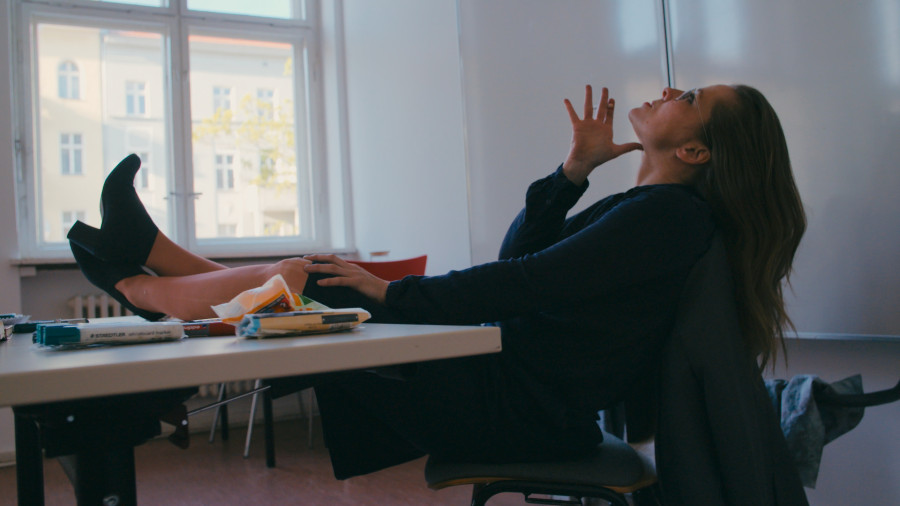
SPECIAL SCREENING AND ARTIST TALK WITH PARY EL-QALQILI
Man darf ja wohl noch schweigen dürfen, Pary El-Qalqili, 2026, 4K video, 16’34”
Eine Lehrerin betritt ein Klassenzimmer. Sie schließt die Tür ab. Sie wischt die Tafel, korrigiert Klassenarbeiten. Was sie aus den Heften vorliest, kommt aus anderen Jahrzehnten: Sätze von Johanna Haarer über Säuglinge, die man schreien lassen soll, bis sie begreifen, dass ihr Schreien nichts nützt. Der Text geht auf einen nationalsozialistischen Erziehungsratgeber zurück, der nach 1945 nur leicht entnazifiziert weiter aufgelegt wurde und Generationen weißdeutscher Mütter prägte. Sätze über die Schule, die das Kind erst zerbrechen müsse, um es brauchbar zu machen. Die Geschichten, die in den Heften stehen, hat sie selbst einmal gelernt und weitergegeben. Das macht das Korrigieren schwierig. Was als Routine beginnt, gerät außer Takt. Irgendwo zwischen Struwwelpeter und Staatsräson verliert sich die Unterscheidung zwischen der, die Ordnung schafft, und der, die ihr nicht entkommt.
Pary El-Qalqili zitiert einen Film, den lange Zeit niemand sehen sollte: Bambule, geschrieben 1969 von Ulrike Meinhof, vor der Ausstrahlung in den Giftschrank verbannt, vierundzwanzig Jahre verschwunden. Meinhof hatte sich von ihrem Regisseur gewünscht, näher an die Wahrheit zu kommen, nicht näher an die Wirklichkeit. Diese Unterscheidung gilt auch hier. Der Film „Man wird ja wohl noch schweigen dürfen“ fragt nicht, wer Schuld trägt. Nicht an der Erziehung, nicht am Unterricht, nicht am Schweigen. Er fragt, was es mit einem Körper macht, jahrzehntelang das Sprachrohr einer Ordnung zu sein, die er selbst nicht mehr verteidigen kann.
⁂
*Please note the time – it should be possible to attend right after the IPK Institutsrat.
⁂
All events will take place at the Kunstraum and will be conducted in English.
⁂
A cooperation between Leuphana Transformation Lab and Kunstraum. Organized by Dr. Henrike Kohpeiß and Christopher Weickenmeier.